
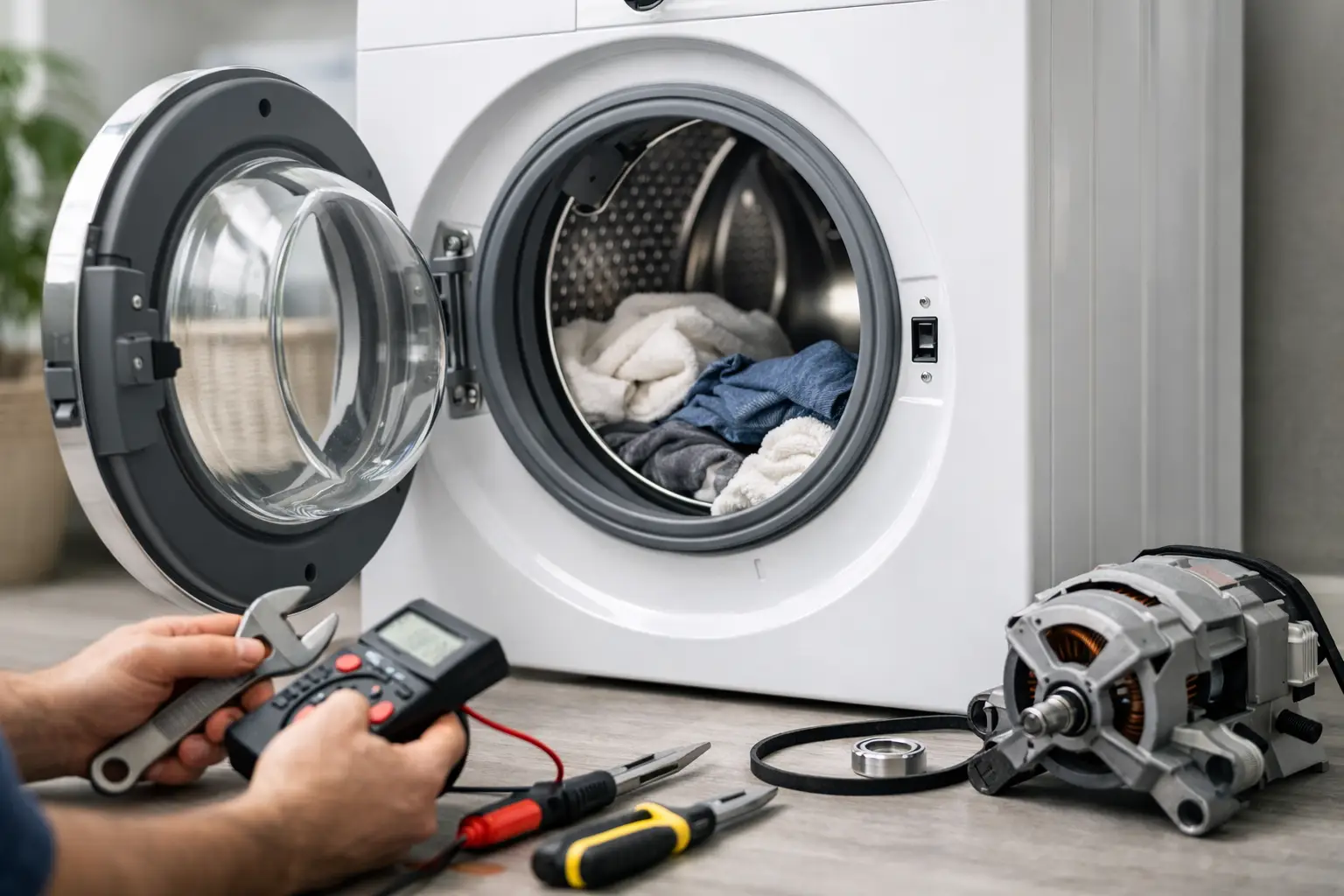
A washer that fills, washes, and drains but will not spin can leave a full load of heavy, dripping clothes at exactly the wrong time. The top causes of washer spin failure range from a simple out-of-balance load to a failed safety switch, worn drive component, or electronic control problem. The good news is that the symptoms often provide useful clues. A careful check can help you tell the difference between a quick reset and a repair that needs a trained technician.
Start With the Load and Washer Position
Before assuming a part has failed, pause the cycle and look at the laundry inside. One large item, such as a comforter, bath mat, or pair of jeans, can settle on one side of the basket. Modern washers are designed to protect themselves from excessive shaking, so they may reduce the spin speed or stop spinning altogether when they sense an unbalanced load.
Redistribute the items evenly, then try the spin or drain-and-spin setting again. If the machine spins normally afterward, the washer itself may be fine. For bulky items, adding a few towels can help balance the load, but do not pack the basket too tightly. Overloading can create the same problem by preventing clothes from moving freely.
The washer also needs to sit level on a solid floor. If it rocks when you press on opposite corners, the adjustable feet may need attention. A level washer is less likely to vibrate, walk across the floor, or trigger an out-of-balance shutdown. This is especially worth checking after a move, new flooring, or installation work.
Top Causes of Washer Spin Failure Inside the Machine
If load balancing does not restore the spin cycle, the issue may involve a component that controls, powers, or transfers movement to the basket.
A faulty lid switch or door lock
Top-load washers typically will not spin unless the lid switch confirms that the lid is closed. Front-load models use a door-lock assembly for the same reason. This is an essential safety feature, not a minor convenience. A washer can agitate or drain in some cases but refuse to enter a high-speed spin if the switch, lock, latch, wiring, or related sensor is not working correctly.
Common signs include a lid that must be pressed down firmly to start, a door-lock light that flashes, a clicking sound near the door, or a cycle that stops just before spinning. Avoid bypassing a lid switch or door lock. Doing so can create a serious injury risk and may cause additional electrical or control damage.
Drainage problems that prevent spinning
Many washers will not spin until they have drained the water from the tub. If water remains inside, the issue may be a clogged drain hose, a blocked pump filter on applicable models, a damaged pump impeller, or a failing drain pump.
Listen closely when the washer reaches the drain portion of the cycle. A low humming sound with little or no water leaving the machine can point to a blocked or jammed pump. A loud grinding noise may indicate debris inside the pump or a worn component. Small objects from pockets, including coins, hairpins, and fabric fibers, can interfere with drainage over time.
Do not tip a washer or open panels around standing water unless you know how to do so safely. Water, electrical connections, and heavy appliance panels are not a good combination for a rushed repair attempt.
A worn belt, clutch, coupler, or drive system
Depending on the washer model, the motor may turn the basket through a belt, clutch, motor coupler, gearcase, pulley, rotor, or other drive components. These parts handle significant force during every spin cycle. As they wear, the motor may run while the basket barely moves or does not move at all.
A burning rubber smell can suggest a slipping belt. Repeated rattling, grinding, or metal-on-metal noise can indicate trouble in the drive system, bearings, or gearcase. On some top-load washers, a worn clutch may allow weak or intermittent spinning. On certain direct-drive models, a broken coupler can cause the washer to stop transferring motor power to the basket.
These failures are not always visible from the outside, and several different parts can produce similar symptoms. Accurate diagnosis matters because replacing the wrong component adds cost without restoring dependable operation.
Motor, capacitor, or speed sensor trouble
The washer motor must produce enough torque to move a wet, heavy load. Some machines use a start capacitor to assist the motor, while others rely on sensors to monitor basket speed and motor position. When one of these components fails, the washer may hum, start and stop, spin slowly, display an error code, or stop partway through the cycle.
An overheated motor can also pause operation until it cools down. If the washer works again later but fails under a normal load, do not assume the issue is resolved. Repeated overheating may signal drag in the drive system, a weak motor, a wiring issue, or a control problem that should be diagnosed before it becomes more expensive.
Control board or wiring failure
Modern washers rely on electronic controls to sequence filling, washing, draining, and spinning. A damaged control board, loose harness connection, corroded wiring, or failed pressure sensor can interrupt the spin command even when the mechanical parts are in good condition.
This category requires more than reading an error code. Error codes are useful starting points, but they can identify a circuit or condition rather than the exact failed part. A professional diagnostic process checks the code, wiring, voltage, switches, sensors, and mechanical operation together. That approach helps avoid replacing a costly control board when the real issue is a worn door lock or drainage obstruction.
Worn tub bearings or basket support components
A loud roaring sound that gets worse as the washer spins is often associated with worn bearings. You may also notice rust-colored marks, water beneath the washer, unusual side-to-side basket movement, or vibration that remains even with a balanced load.
Bearing repairs can be labor-intensive because the machine may need significant disassembly. Whether repair makes financial sense depends on the washer’s age, condition, brand, and the extent of the damage. A clear estimate gives you the information needed to choose between repair and replacement without guesswork.
What You Can Safely Check Before Scheduling Service
A few homeowner checks can save time and help describe the problem clearly. First, confirm that the washer is plugged in, the circuit breaker has not tripped, and the water supply is on. Then redistribute the load, check whether the washer is level, and run a spin-only cycle with the drum empty if your model allows it.
Look for a kinked drain hose or a hose pushed too far into the standpipe. If your washer has an accessible pump filter and the manufacturer instructions allow homeowner cleaning, follow those instructions carefully and prepare for water to drain out. Also note any error message, unusual sound, burning smell, leak, or point in the cycle where the washer stops.
Do not continue running the washer if you smell burning, hear severe grinding, see smoke, or find water near electrical connections. Turn the appliance off and arrange service. Repeated attempts can turn a manageable repair into damage to the motor, control board, flooring, or nearby cabinetry.
When a Professional Washer Repair Is the Better Choice
Washer spin failures can look alike from the laundry room. A drain pump issue, door-lock fault, motor problem, and control-board failure may all leave you with wet clothes and a stalled cycle. Testing electrical components, removing panels, and handling heavy washers safely takes the right tools and experience.
For homeowners across North Texas, IAS Appliance Solutions provides straightforward in-home washer diagnostics and repair for major brands. A technician can identify the cause, explain the repair in plain language, provide upfront pricing, and complete the work on the first visit whenever the needed part is available.
A washer that will not spin does not always mean it is time to replace the appliance. Start with the load, level, and drainage checks, then let a proper diagnosis guide the next step. The right repair can get the laundry routine moving again with minimal disruption to your household.




No comment