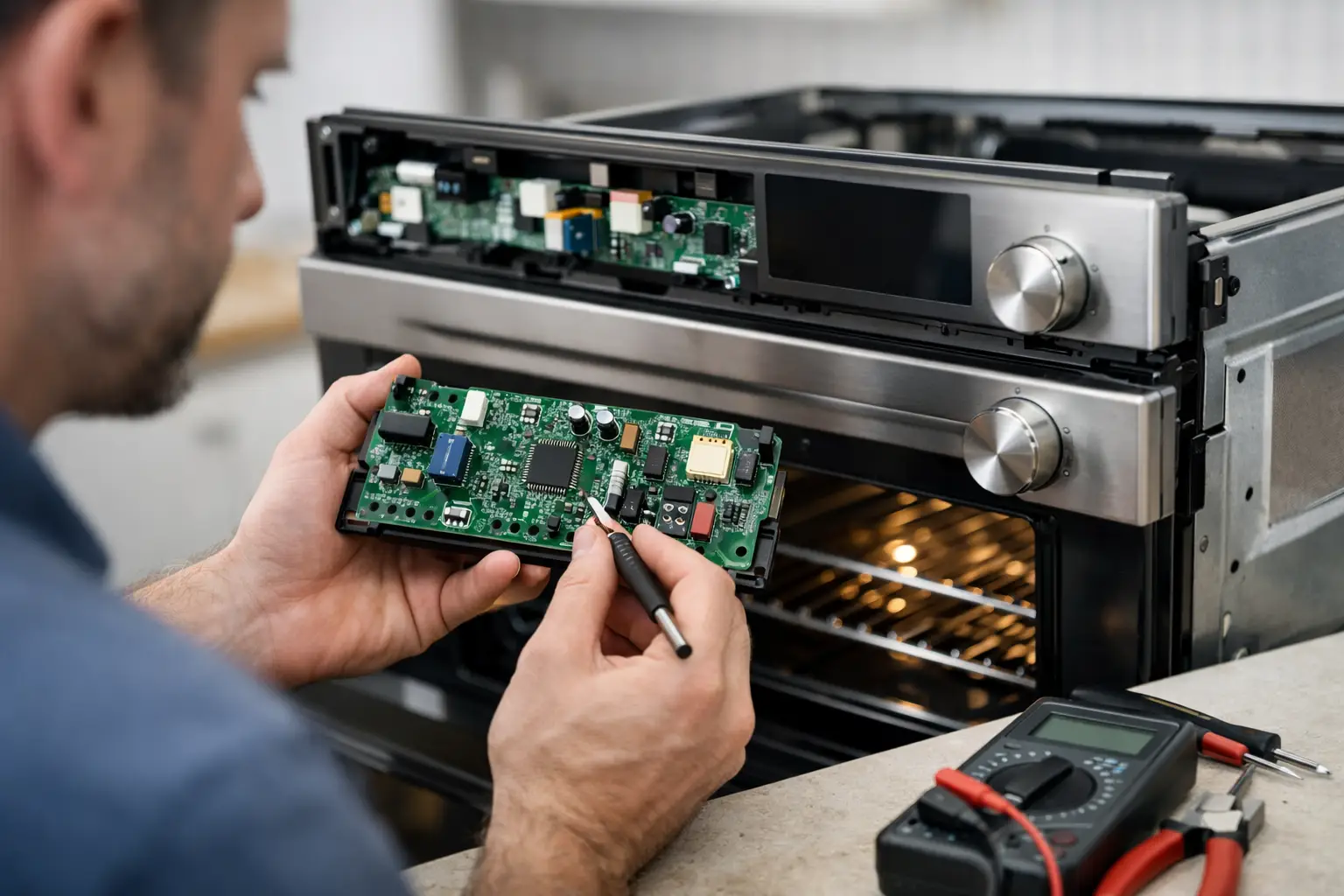
A wall oven that will not heat, a range that displays an error code, or controls that respond on their own can turn dinner plans into a problem fast. Oven control board repairs address the electronic component that receives commands from the keypad, manages heating cycles, and communicates with important oven parts. When that board fails, the symptoms can look serious, but the board is not always the cause.
For homeowners, the priority is getting a clear answer before approving an expensive repair. A trained appliance technician can identify whether the control board is truly at fault, whether a related part has caused the failure, and whether repairing the oven is the practical choice for your household.
What an oven control board does
The control board is the oven’s electronic command center. Depending on the model, it manages the bake and broil elements, temperature sensor, convection fan, display, clock, door lock, igniter, and safety functions. It tells the oven when to heat and when to stop heating based on the temperature selected and the information it receives from connected components.
On many modern ovens, the display and touch controls are part of the same electronic assembly or closely connected to it. That is why a blank display, flashing clock, unresponsive buttons, and incorrect temperatures can all raise questions about the board.
Still, electronic controls are only one part of the system. A failed temperature sensor, damaged wiring harness, worn relay, faulty heating element, or weak power supply can create nearly identical symptoms. Replacing a control board without proper testing can leave you with the same issue and an unnecessary parts bill.
Signs you may need oven control board repairs
A control board problem often shows up as inconsistent behavior rather than a complete shutdown. You may set the oven to 350 degrees and find it barely warms up, overheats, or cycles on and off at the wrong times. The display may show an error code, reset unexpectedly, or fail to accept settings.
Other warning signs include a bake or broil element that stays on after the oven has been turned off, a self-clean cycle that will not start, or a locked door that will not release once the oven has cooled. Some homeowners also notice intermittent operation: the oven works normally for several days, then stops heating or displays a fault message again.
An oven that continues heating when switched off deserves immediate attention. Turn off power to the appliance at the breaker if it is safe to do so, avoid using the oven, and arrange for service. Continued heating can damage the appliance and create a safety risk.
Why an accurate diagnosis matters
Control boards are often among the more costly oven components. That makes diagnosis especially important. A technician will typically inspect the appliance’s power supply, check for visible heat damage or loose connections, test the heating elements or igniter, and evaluate temperature-sensor readings before recommending a board repair or replacement.
For example, an electric oven with a burned-out bake element may fail to heat from the bottom even though the display appears to work correctly. A gas oven may have a weak igniter that prevents the burner from lighting, even when the control board is sending the correct command. In both cases, a board replacement would not solve the underlying issue.
The reverse can also happen. If the sensor, wiring, heating components, and power supply test properly but the oven is sending erratic output or will not respond to commands, the electronic control may be the likely failure point. This process protects your budget by focusing the repair on the part that actually needs attention.
Repairing the board versus replacing it
Whether an oven control board can be repaired depends on the board design, the extent of damage, and parts availability. Some failures involve damaged relays, burned connections, or electronic components that can be professionally repaired. In other cases, replacing the complete manufacturer-approved control board is the more dependable option.
Replacement can be the better choice when the board has severe heat damage, corrosion, repeated failures, or a known issue that affects multiple circuits. It may also be appropriate when a repaired board would not carry the same reliability or warranty protection as a replacement part.
Age matters, but it is not the only factor. A quality wall oven or range that is otherwise in good condition may be well worth repairing, even if it is several years old. On the other hand, if the oven has multiple expensive failures, discontinued parts, or major wear beyond the control board, replacement may be a more sensible long-term decision. An honest assessment should account for the appliance’s condition, expected repair cost, and how long you plan to keep it.
What to expect from professional oven control board repair
The service visit should begin with a conversation about what the oven is doing and when the problem occurs. If you have seen an error code, taken a photo of the display, or noticed whether the issue happens during bake, broil, convection, or self-cleaning, share those details. They can help narrow the diagnosis.
During the appointment, the technician safely tests the appliance and explains the findings in plain language. If a control board or another part is needed, you should receive clear pricing before work begins. The exact turnaround time depends on whether the appropriate part is available for your oven’s make and model. A well-stocked service vehicle can help with many common repairs, while specialized boards may need to be ordered.
At IAS Appliance Solutions, the goal is to minimize disruption with a practical diagnosis, transparent upfront pricing, and a repair that is built to last. Experienced technicians service major oven and range brands throughout North Texas and can help homeowners decide whether a control board repair, replacement part, or a different repair is the right path.
Can a power surge damage an oven control board?
Yes. A power outage, electrical surge, or lightning event can damage sensitive electronic components in an oven. Sometimes the damage is immediate, such as a blank display after power returns. Other times, the board develops intermittent issues that become more noticeable over time.
However, not every problem that follows an outage is a failed board. A tripped breaker, loose electrical connection, or incorrect voltage can also affect oven operation. If several appliances in the home behaved unusually after a power event, it is wise to consider both appliance service and an evaluation of the home’s electrical system.
Can you prevent future control board problems?
You cannot prevent every electronic failure, but a few habits can reduce unnecessary strain. Keep oven vents clear, avoid slamming the door, and address temperature or error-code issues early rather than repeatedly forcing the appliance through failed cycles. Excessive heat, moisture, grease buildup around controls, and unstable power can all shorten the life of electronic parts.
Self-clean cycles deserve some consideration as well. They are a normal feature, but the extreme temperatures can be hard on older oven components. If your oven has already shown electronic or door-lock issues, ask a technician whether using the self-clean function is advisable for that model.
A reliable oven should heat evenly, respond predictably, and give you confidence when you are feeding your family or preparing for guests. If yours is doing anything less, a professional diagnosis can replace uncertainty with a clear, cost-conscious next step.

No comment